
Incorrectly specified gaskets rarely announce the problem until the joint fails. When they do, the consequences extend well beyond the seal itself: unplanned downtime, rework, potential contamination, and in critical systems, a safety incident. The part itself might cost less than a pound. Downtime costs in process-critical environments can run into thousands of pounds per hour. Getting the specification right at the outset is therefore an engineering discipline, not an afterthought.
This guide covers the main types of gaskets used in industrial and precision engineering, how to select the right material for your service conditions, how to write a complete dimensional specification that a supplier can act on without repeated queries, and how modern laser cutting delivers custom metal gaskets faster than most engineers expect. The guidance draws on the manufacturing expertise of Hollinbrow Precision Products (UK) Ltd, a precision thin metal specialist working with engineers across aerospace, defence, and heavy industry.
One pattern recurs consistently across engineering enquiries: soft seals handle most low-to-medium pressure applications well, but engineers regularly underspecify when conditions push beyond those limits. Extreme temperature, high pressure, thermal cycling, and aggressive chemistry all demand a precision-cut metal seal. Understanding where that threshold lies is the starting point for every specification decision.
The main types of gaskets and where each one belongs
Choosing between gasket types is not a matter of preference. It follows directly from the joint geometry, pressure class, and service medium. Selecting the wrong category at the outset means every downstream decision, from material to tolerance to manufacturing method, is built on a flawed foundation.
Flange gaskets for piping and pressure vessels
Flange gaskets seal static joints between pipe flanges, valves, heat exchangers, and pressure vessels. Full-face designs contact the entire flange face and are used on flat-face flanges, particularly with brittle flange materials. Raised-face variants seat only within the bolt circle and are the standard choice for steel flanges in process piping. For high-pressure and high-temperature service in oil, gas, and refinery applications, ring-type joint (RTJ) gaskets are the appropriate selection: oval or octagonal metal rings that seat into a precision-machined groove in the flange face, achieving a seal through plastic deformation rather than compression of a flat sheet.
Sheet gaskets for general industrial and chemical service
Cut sheet gaskets in rubber, fibre, graphite, and PTFE cover the broad middle ground of industrial sealing: low-to-medium pressure flanges, HVAC systems, chemical service lines, and general plumbing. PTFE gaskets and graphite sheet handle a wide chemical range and are widely available from stock, though both have clear pressure and temperature ceilings beyond which they are not appropriate. O-rings occupy a separate category for compact groove seals in hydraulic and pneumatic systems, offering reliable performance in dynamic and static applications where a circular-section seal suits the groove geometry.
Metal gaskets for extreme service conditions
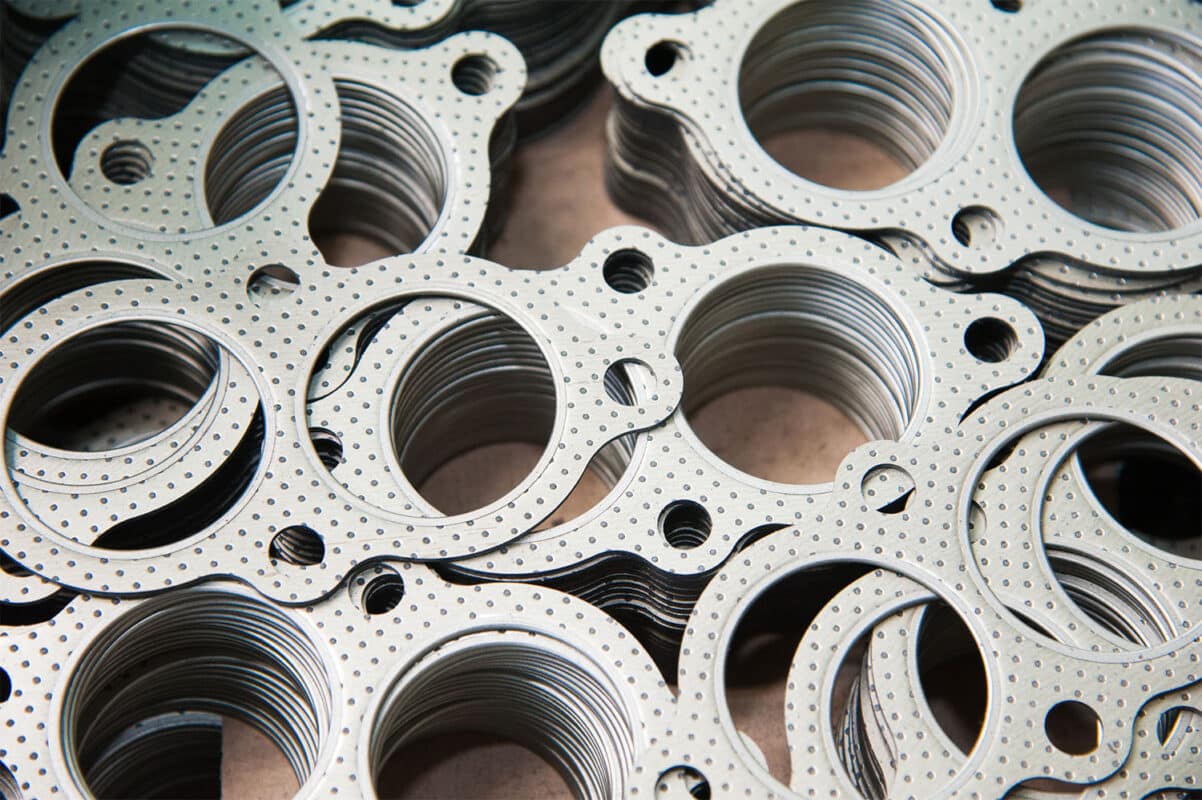
Solid metal, spiral-wound, and metal-jacketed gaskets are the right choice where soft seals cannot perform reliably. Spiral-wound gaskets use alternating metal and filler windings to combine resilience with temperature resistance. Solid metal gaskets, including thin sheet profiles laser-cut from stainless steel, Inconel, or titanium, provide the geometry control and surface hardness that extreme service demands. These are the seals that maintain their sealing land under sustained high bolt load, thermal cycling, and pressure fluctuation.
Choosing the right gasket material: metal alloys versus soft seals
Material selection comes down to three variables every time: maximum service temperature, system pressure, and chemical environment. Getting any one of these wrong is how metal seals and soft seals alike fail prematurely, and how maintenance teams end up replacing the same joint twice.
Temperature, pressure, and chemical compatibility
PTFE operates across roughly -200°C to +260°C and resists almost all acids, alkalis, and solvents. Its weakness is mechanical: virgin PTFE creeps under sustained compressive load, making it unsuitable for high bolt-load flanges without a reinforced or filled grade. Graphite performs well at higher temperatures and suits steam and hydrocarbon service, but degrades in strongly oxidising environments. Nitrile (NBR) suits oils and fuels at moderate temperatures, while EPDM handles water, steam, and dilute acids reliably yet is incompatible with petroleum-based media. Cork is limited to mild service at low pressure. Metal gaskets take over wherever temperatures exceed the ceiling of soft seal materials, pressures are high, or dimensional stability under thermal cycling is non-negotiable.
When metal outperforms PTFE, graphite, and rubber
Soft seals compress and conform to sealing faces; precision-cut metal seals maintain their geometry. In bolted joints subject to thermal cycling, vibration, or sustained high pressure, a metal gasket holds its thickness and sealing land far better than any compressible material. The key properties are creep resistance and surface hardness. A metal gasket does not flow under load, it seats against the flange face and stays there. For critical service, that predictability is the engineering requirement, not merely a preference.
Stainless, Inconel, and titanium for aerospace and defence
Where the alloy choice is itself part of the specification, the selection logic is straightforward. Stainless steel grades 304 and 316 cover most corrosive and moderate-temperature service, with other austenitic grades available as required. Inconel 625 and 718 are well suited to combustion environments, exhaust-adjacent seals, and high-temperature joints where stainless would lose strength. Titanium Grade 5 (Ti-6Al-4V) brings exceptional corrosion resistance at low weight, making it a preferred option for aerospace structural and fluid system seals. Hastelloy C-276 suits the most aggressive chemical environments. Hollinbrow Precision Products laser cuts all of these alloys to order, from prototype quantities through to production batches.
How to measure and specify your gasket correctly
This is the step most engineers rush, and the one that generates the most supplier queries and re-orders. A complete specification eliminates ambiguity and allows a competent manufacturer to cut and inspect the part without a single clarifying question.
Recording the critical dimensions
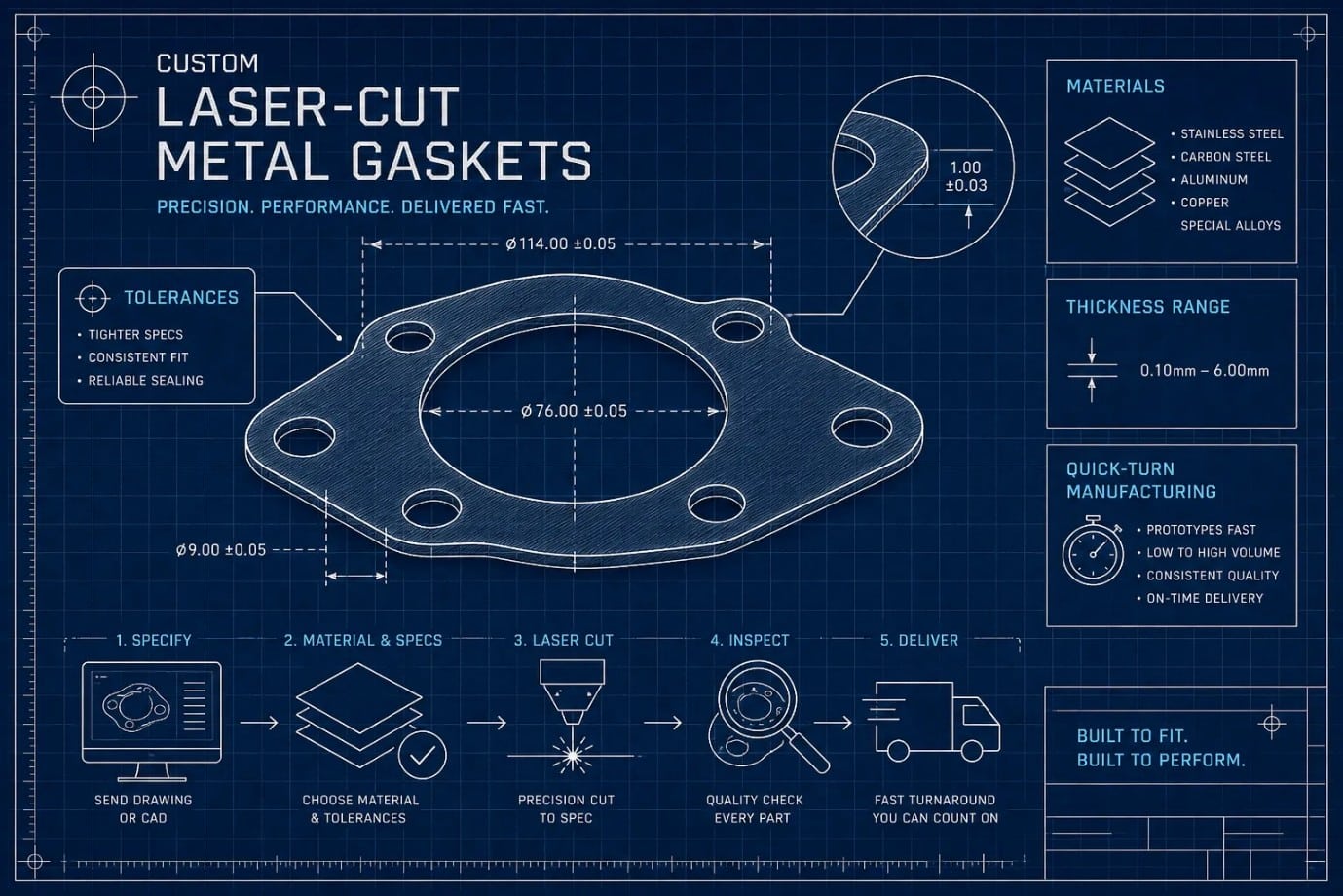
Lay the gasket flat in its uncompressed state. Measure the outer diameter (OD) across the widest external edges, then measure the inner diameter (ID) across the bore opening. Take thickness readings at several points using callipers or a thickness gauge: used gaskets are often unevenly compressed, so a single measurement can mislead. If bolt holes are present, record the number of holes, hole diameter, and pitch circle diameter (PCD). For non-round profiles, record all straight-side dimensions, curved-end dimensions, and any locating features or cutouts.
Flange standards, surface finish, and tolerance control
The flange standard determines bolt pattern, gasket face dimensions, and compatibility. Common standards include BS EN 1092-1 with gasket dimensions from BS EN 1514-1 for PN-designated flanges, and ASME B16.20 or B16.21 for ASME-class flanges. For metal gaskets specifically, the surface finish of the sealing face is a specification variable: metallic and ring-type joint faces typically require Ra 1.6 µm or finer to achieve a reliable seal, with BX-type RTJ faces often requiring Ra 0.8 µm. Thickness tolerance is the variable that separates precision laser-cut metal gaskets from blanked sheet: even small deviations, on the order of hundredths of a millimetre, can affect load distribution and sealing performance across the joint.
Writing a complete specification your supplier can quote from
A well-formed specification string gives every piece of information a manufacturer needs: “Gasket, annular, ID × OD × thickness, material grade, N bolt holes on PCD, hole diameter, flange standard, face type, quantity.” This format allows quoting, cutting, and dimensional inspection without a back-and-forth. For complex profiles, submitting a DXF file or dimensioned PDF drawing is cleaner still and removes any risk of transcription error in the critical dimensions.
Manufacturing methods: laser cutting, stamping, and CNC finishing
The manufacturing method chosen to produce a metal gasket directly determines achievable dimensional accuracy, edge quality, and minimum usable thickness. For thin metal gaskets in particular, method selection is not a secondary consideration.
Why laser cutting is the method of choice for thin metal stock
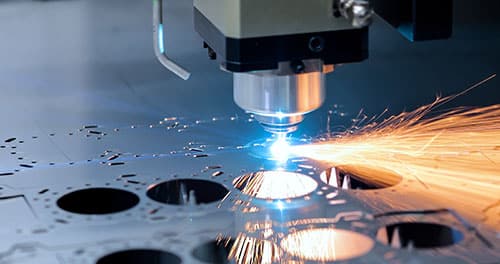
Fibre laser cutting is the precision method for custom metal gaskets at low-to-medium quantities. There are no tooling costs for one-offs or small batches, no burrs from tool contact, and tight tolerances are achievable across complex profiles. On well-controlled thin sheet work, fibre lasers routinely hold ±0.1 mm, with ±0.05 mm achievable on thin material and critical features. Laser-cut edges on thin stainless or titanium produce a clean sealing land, avoiding many of the deformation issues associated with mechanical stamping on very thin gauges. This matters directly when you are sealing against a precision-machined flange face.
Stamping and CNC finishing for volume and complex profiles
Stamping becomes the economical choice at production volumes where tooling cost is amortised across large quantities. CNC milling and turning come into play for thicker metal gaskets requiring machined grooves, raised faces, or integrated features. Some high-precision metal gaskets use a combined approach: a laser-cut blank followed by CNC finishing of the sealing face to a specified Ra value. The manufacturing route should follow the tolerance requirement, not the other way around.
What Hollinbrow Precision Products brings to custom metal gasket manufacture
Hollinbrow Precision Products laser cuts custom metal gaskets from very thin sheet stock, including foil-gauge material, across a broad thickness range in stainless steel shim and foil. Specialty alloys including Inconel, titanium, phosphor bronze, and Hastelloy are available to cut to order. Every part ships with documented material traceability to heat and lot, dimensional inspection records with actual measured values, and full quality evidence, supporting aerospace and defence procurement teams who need a reliable, auditable supply chain.
Order custom metal gaskets in the UK, lead times and getting started
Plant breakdowns do not wait for standard lead times. A failed seal in a critical system can shut down an entire production line, and the hourly cost of that downtime is rarely comparable to the cost of the replacement part. Fast, reliable supply is therefore a specification requirement in its own right, not a luxury.
Same-day production for emergency replacements
For urgent requirements, specialist laser-cutting operations can offer rapid-turnaround production where a dimensional specification or DXF file submitted in the morning can result in a laser-cut metal gasket leaving the facility the same day, subject to material availability and cutting schedule. This capability matters in industrial maintenance, aerospace MRO, and defence service environments where every hour of unplanned downtime carries a documented cost. Where a supplier holds in-house specialty alloy stock, the lead time constraint is typically the cutting schedule rather than material sourcing, so it is worth confirming stock holdings when you make contact.
Certified quality for aerospace, defence, and critical industry
AS9100 Rev D certification requires more than a quality statement on a delivery note. It mandates positive traceability from raw material heat and lot through manufacturing and final inspection to the finished part. Dimensional inspection records must preserve actual measured values tied to the specific part or batch, the drawing revision, and the inspection equipment used. For engineers ordering custom metal gaskets into safety-critical applications, that level of documented evidence is what makes a certified supplier the defensible choice at audit.
How to place an order and what to send
Submitting a DXF file or dimensioned drawing alongside a clear material specification and required quantity is the fastest route to a first-time-correct result. Include material grade, thickness, any surface finish requirement on the sealing face, and flag the order as urgent if fast-turnaround service is needed. A complete specification paired with available alloy stock means most custom metal gaskets can be produced and shipped without a lengthy quotation cycle. Get in touch with the Hollinbrow team directly to submit a specification enquiry.
Specification discipline pays for itself
The decision framework is straightforward once the variables are clear: identify the joint conditions, select the material class that meets the temperature, pressure, and chemical requirement, write the dimensional specification using the measurement sequence above, and choose a manufacturing method suited to the required tolerance and batch size.
The core point holds across every application: for extreme temperature, high pressure, thermal cycling, or aggressive chemical service, a precision laser-cut metal gasket is what the application demands over soft seals. The specification discipline required to get it right is not complex. It is a matter of measuring carefully, understanding the flange standard, and working with a supplier who holds the alloy stock and the manufacturing capability to execute without compromise.
Hollinbrow Precision Products (UK) Ltd supplies custom laser-cut metal gaskets in stainless steel, Inconel, titanium, and a range of specialty alloys, from single prototypes to production batches, with full quality documentation on every order. Typical turnaround for standard alloy profiles is fast, and the team can advise on material selection, surface finish, and tolerance requirements from the outset. If you have a replacement seal to specify or a new design to cut, send your drawing or specification to the team and get a prompt response.
Contact Hollinbrow to discuss your metal gaskets requirements. We would be happy to help.
